


Effective cargo lift spare parts planning is a critical part of long-term equipment reliability and operational safety. Without the right components available at the right time, even minor failures can result in extended downtime, production delays, and unexpected repair costs.
This article outlines a practical, data-driven approach to identifying critical spare parts, managing lead times, and building a balanced inventory strategy for industrial cargo lift systems.
Identifying Critical Cargo Lift Spare Parts
First of all, operators must clearly identify critical spare parts. These are components whose failure can stop the cargo lift or affect safety.
In most cargo lift systems, critical spare parts include:
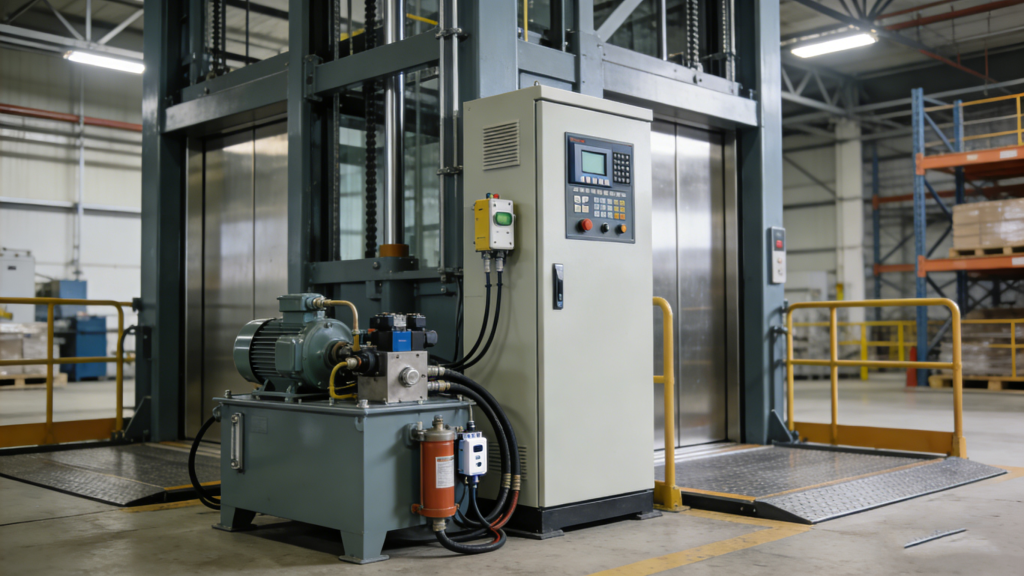
- Hydraulic power units
- Electrical control boards and PLC modules
- Limit switches and safety devices
- Contactors and relays
- Position, load, and door sensors
Among these, electrical and control components usually create the longest downtime. This happens because replacements often require exact specifications, compatibility checks, and testing before commissioning.
Distinguishing Consumable and Strategic Spare Parts
Next, it is important to separate consumable parts from strategic spare parts.
Hydraulic seals, hoses, and valves fall into the consumable category. These components follow predictable wear cycles and require regular replacement. As a result, operators should stock them based on operating hours and maintenance schedules.
On the other hand, customized electrical panels and PLC components fail less frequently. However, when failure occurs, sourcing replacements takes much longer. Therefore, these parts should be treated as strategic spare parts, especially for high-duty cargo lift installations.
Managing Lead Times for Cargo Lift Spare Parts
In addition, lead time directly affects spare parts planning and downtime risk.
In general:
- Standard mechanical parts require around 1–3 weeks
- Customized electrical panels or PLC units often require 4–8 weeks or more
- Overseas strategic spares may take even longer due to production scheduling, export procedures, and international shipping
Because many cargo lifts are imported equipment, longer supply chains increase operational risk if critical spare parts are not prepared in advance.
Planning a Realistic Spare Parts Budget
Furthermore, companies should plan spare parts budgets in advance rather than react after failures occur.
In practice, annual spare parts budgets are usually calculated as a percentage of the cargo lift’s total equipment value. Higher budget allocations are common for:
- Continuous or high-frequency operations
- Mission-critical facilities such as factories or logistics hubs
- Harsh environments that accelerate component wear
With a clear budget, companies can avoid emergency purchases and expensive express freight.
Using Maintenance Data to Optimize Inventory
Equally important, maintenance records provide valuable guidance for spare parts planning.
By reviewing maintenance logs and failure histories, operators can:
- Identify high-consumption spare parts
- Reduce excess stock of low-risk components
- Adjust minimum and maximum inventory levels over time
Moreover, digital inventory systems or basic ERP tools help track usage trends and support better long-term decision-making.
Bundling Spare Parts with Initial Cargo Lift Orders
Another effective approach involves bundling a year-one spare parts kit with the initial order.
This method offers several advantages. For example, it ensures spare parts availability during commissioning, reduces emergency logistics costs, and guarantees compatibility with the delivered equipment.
For many overseas projects, bundled spare parts provide better cost control and smoother early operation.
Building a Balanced Cargo Lift Spare Parts Strategy
In conclusion, a successful cargo lift spare parts strategy balances inventory cost with downtime risk.
To achieve this balance, operators should prioritize parts that directly affect safety, system availability, and business continuity. By combining criticality assessment, lead time analysis, and data-driven inventory management, companies can significantly improve cargo lift reliability while keeping lifecycle costs under control.
About Our Company
As a professional cargo lift manufacturer and export supplier, we support customers not only with equipment delivery but also with long-term spare parts planning. From spare parts kits to technical documentation and after-sales support, we help ensure stable cargo lift operation throughout the entire service life.
Email: service@sunlanglift.com
Website: https://sunlanglift.com
